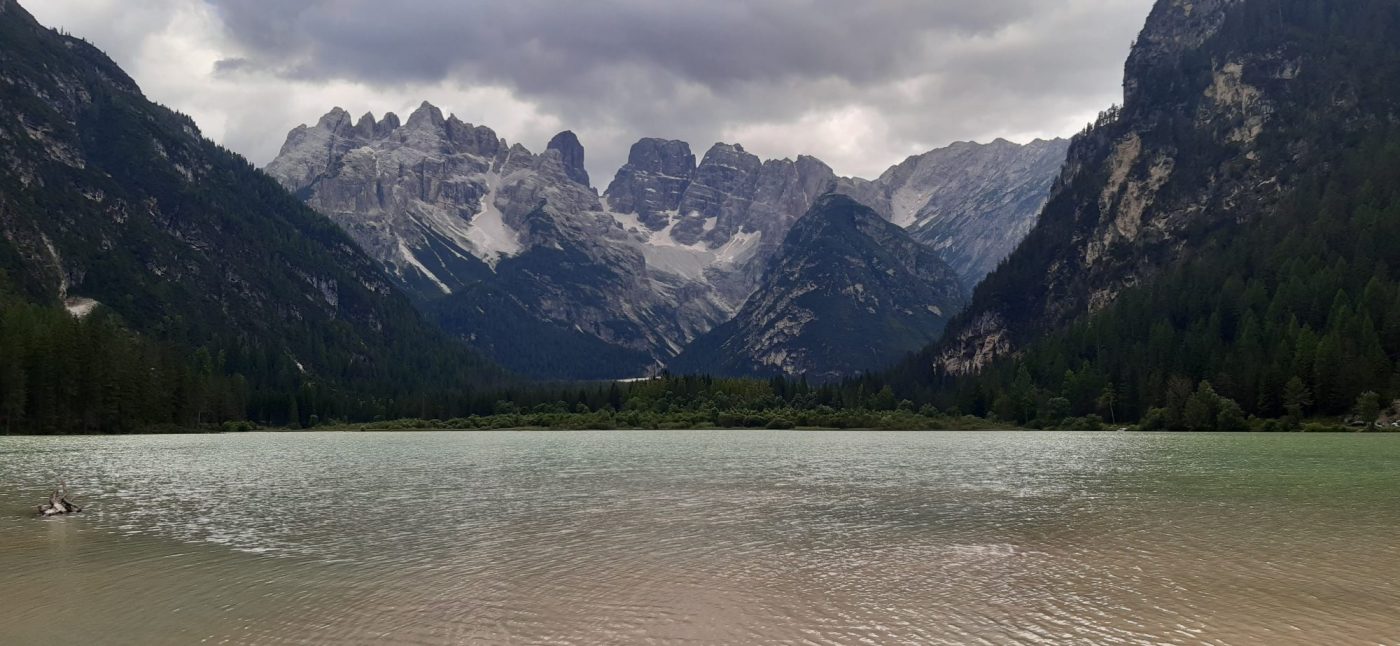
I love the rock in the UK. It’s varied, it’s often esoteric, and on the few days per year when it is completely dry, it hosts some pretty phenomenal climbing. But in the grand scheme of things, there’s not really a lot of it. Our cliffs may delight and intimidate, but they don’t often soar, unbroken for hundreds of metres. If, like me, you’ve spent the whole of your climbing career looking up at British rock and hot rock sport crags, then you may find yourself completely unprepared for the imposing majesty of the Alps, and just the sheer amount of rock.
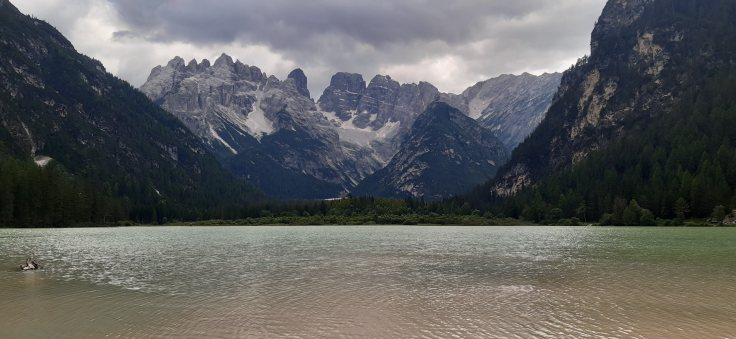
In particular, I’m talking about the Dolomites, in north-eastern Italy.
When I originally pitched a summer alpine trip to Sophie, I hadn’t considered the Dolomites. But I hadn’t realised just how much snow is involved in a French alpine summer, and I’d had quite enough of that on my winter Scotland trip, thanks very much. In the end, the Dolomites won out, thanks to their Kate-friendly temperatures and being one of the very few places that Sophie hasn’t already climbed.
First impressions: A lot of rock
We flew out on the day that Microsoft imploded, leaving us wondering if we were going to make it at all, or if we were just going to spend 10 days queuing for check in at Manchester airport. We did make it in the end, but so late that we had to shell out an inordinate amount for a hostel in Venice since the car hire place was long closed for the night (remember when hostels used to be cheap?).
The scenery on the drive up was almost immediately beautiful, but I was still completely unprepared for the views of the mountains that awaited me. Over the course of the two-hour drive, fields of twisted olive trees and farmland gradually transitioned into hillsides coated in densely packed conifers. The cream stucco and terracotta tiles synonymous with Mediterranean houses morphed into the timber gables of alpine chalets, their balconies dripping with pink and red flowers.
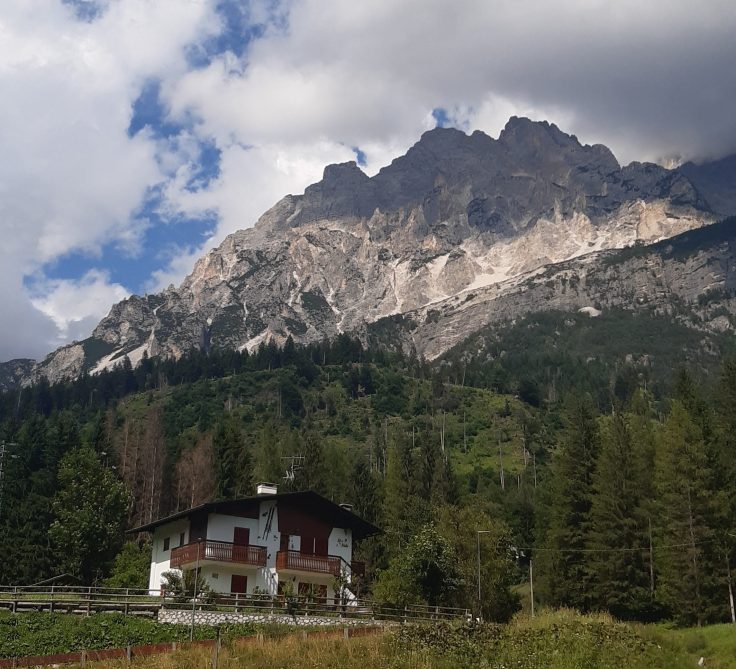
As we drew closer to Cortina d’Ampezzo the mountains began to appear. Rising like jagged teeth, the cliffs and peaks of the Dolomites really do soar. Row after row of sharp, fin-like towers dwarf the alpine towns and villages that line the lush, wildflower strewn valleys, and they leave naïve, unworldly little climbers like me completely breathless in awe.
Although the town of Cortina itself was a little too up-market and touristy for me, the Cortina Camping campsite everything we needed as a base. We had a pitch shaded by tall pines, and the old Italian Nonnas in the more permanent tiny wood cabins surrounding our tent quickly adopted us, offering us home-baked cake and testing my extremely limited Italian with their streams of friendly greetings.
Finding my feet
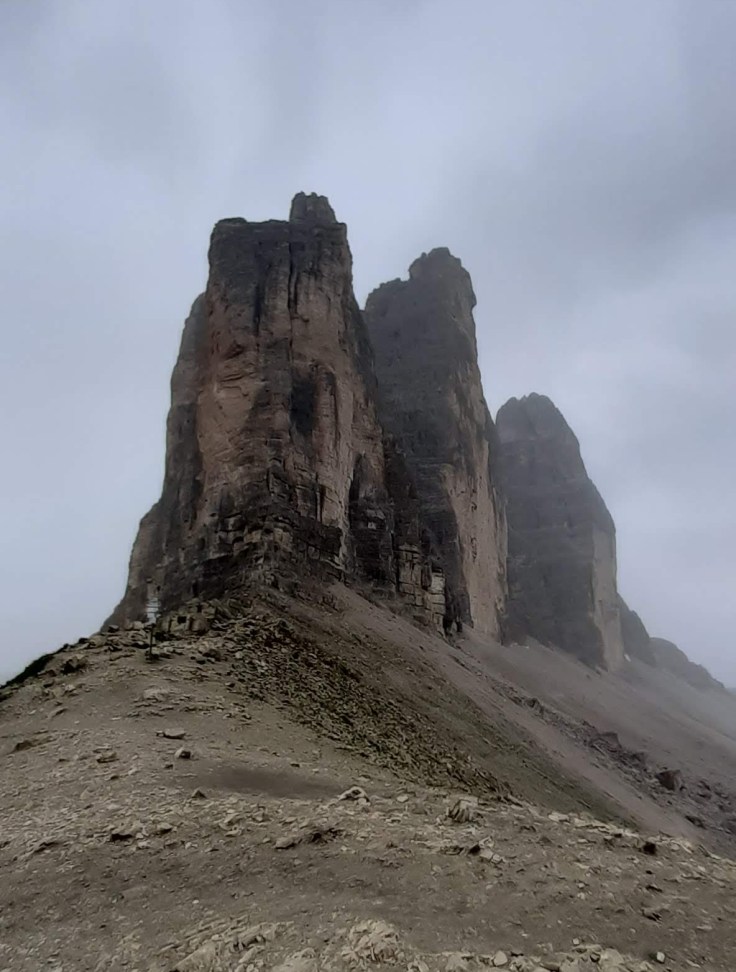
We eased into the climbing with a 9 pitch route – Cassin at the Tre Cime – which seems wild to say when previously the longest route I’d ever done was no more than 5 pitches. If you’re not already aware of them, the Tre Cime are perhaps the most famous skyline in the Dolomites. Three freestanding limestone towers, erupting from a mound of scree like giant fingers clawing out of a grave. The rock was strange, different to limestone I’ve climbed before. Even without polish it was glassy and smooth, making me nervous of the sloping footholds. It was also difficult to read, with hidden holds and odd angles. It took me a few pitches to settle into it, but by the time I lead the incredible exposed traverse of pitch 5 I was delighting in the views of microscopic hikers on the main path and the hundreds of metres of empty space below my feet.
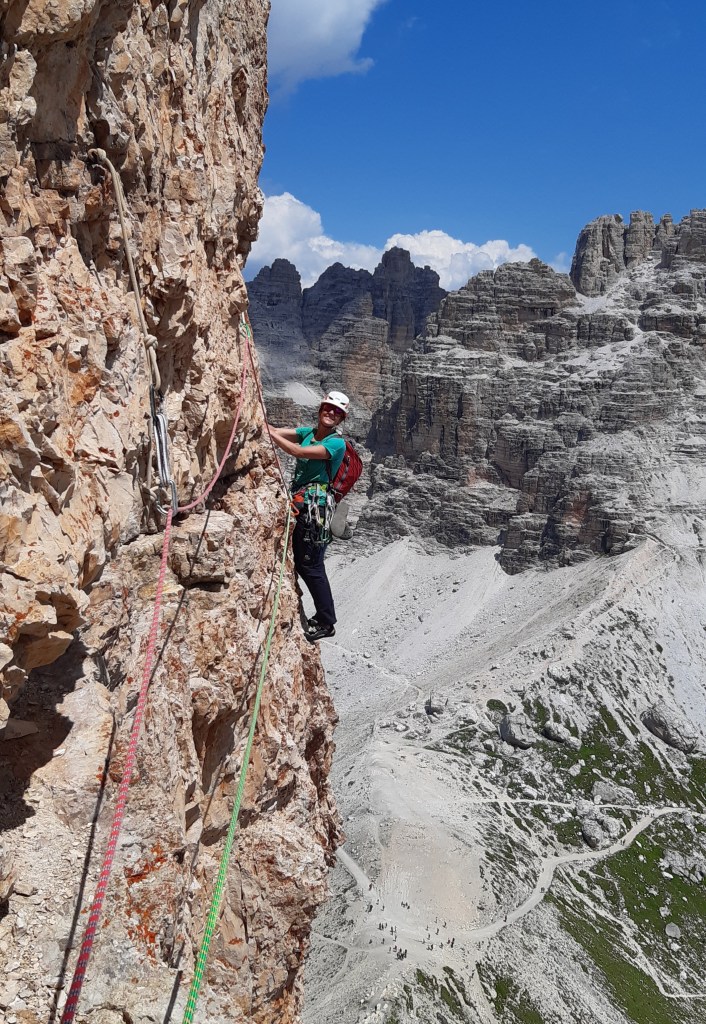
We timed the route perfectly. As we finished the climbing and began the series of abseils for the descent, the clouds we’d been carefully ignoring all day continued to amass. Just as we touched down on the final abseil they ruptured, releasing a deluge of biblical levels. Lightning cracked the sky open and thunder rolled, echoing off the rocks around us. We got unbelievably drenched on the walk back to the car, but that was far preferable to still being at the top of the Cima Piccola, covered in metal, in the middle of an electrical storm.
Over the course of the next few days, we did the phenomenal Finlandia at the Cinque Torri (perhaps my favourite multipitch ever?), had a “rest day” that involved hiking up the 2,778m Laguzuoi Piccolo then descending through the fascinating World War I tunnels*, and my first taste of a truly big route, the 500m Via Constantini-Ghedina on Tofana di Rozes.
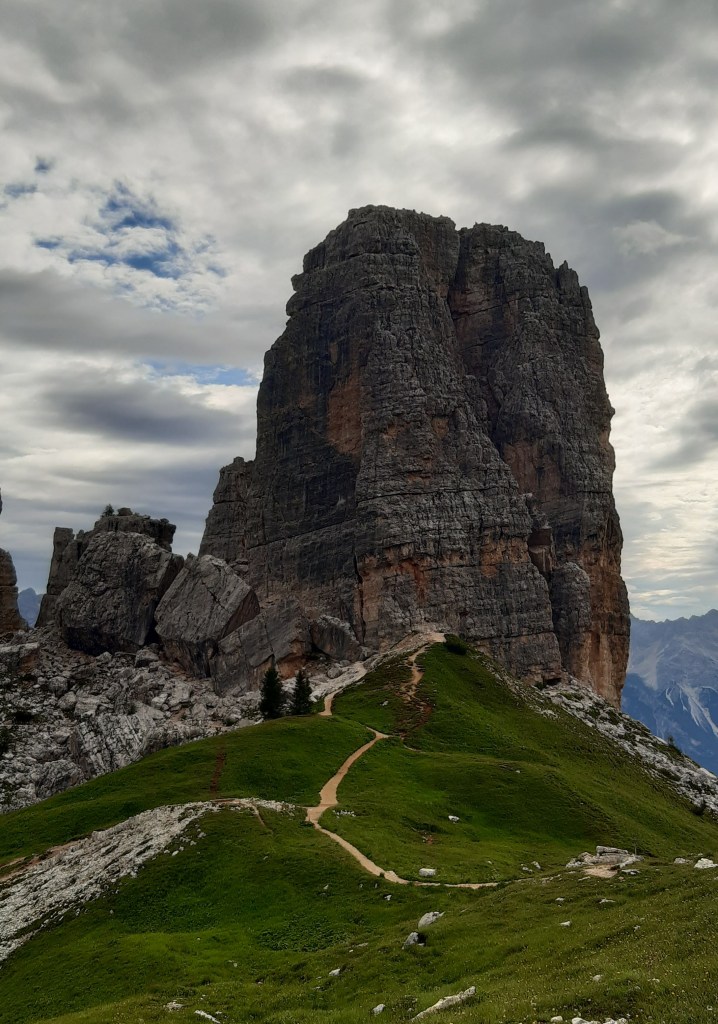
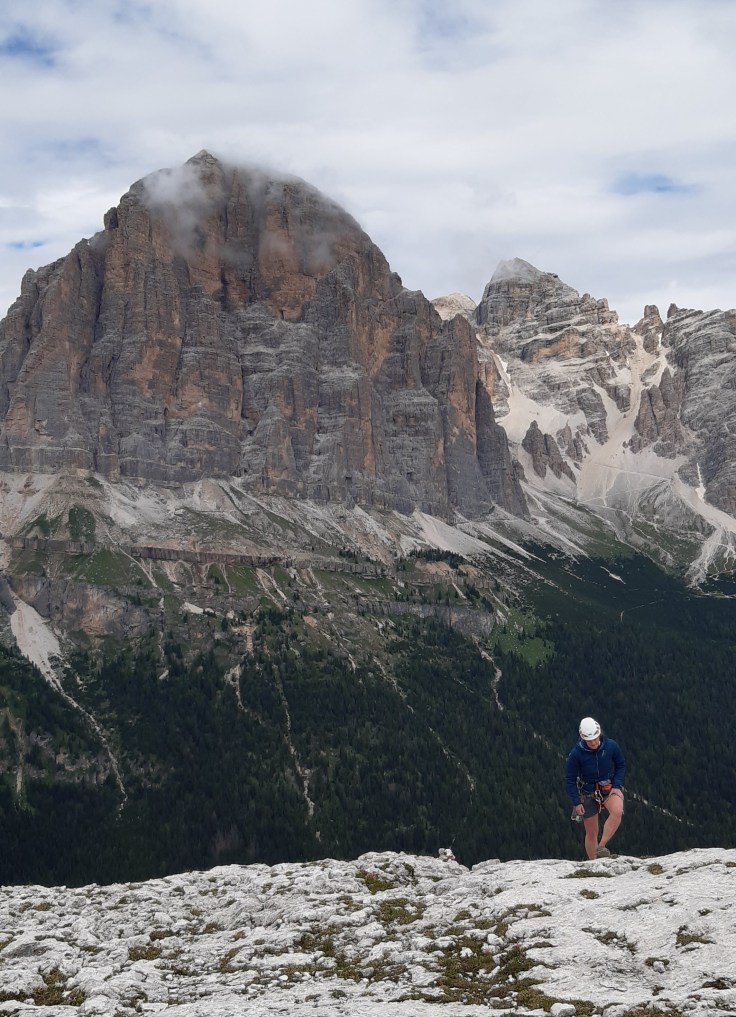
The culmination of the trip, and the route I want to focus on here, was the Dolomite classic, and an altogether mind-blowing route on the Tre Cime: the 520m, 17 pitch Comici-Dimai.
Swinging leads for sunrise : Comici-Dimai
There were a lot of firsts for me on this trip, including, unpleasantly, my first ever alpine start. I managed to drag myself out of my sleeping bag at 2:45am, for the earliest breakfast I’ve ever choked down. As miserable as the early morning was, the blue-hour, pre-dawn views of the cloud inversion were worth all of it. As we came around the north sides of the Tre Cime, the black fangs of the towers were silhouetted moodily against the navy sky. We skirted around the bases, aiming for the middle, the Cima Grande. Between the drive, the gearing up faff and the walk-in, we arrived at the base of the route at 5:40am, and started the easy scramble up the first 80m to the first roped pitch. As early as we were, four other parties had had the same idea: two ahead of us, two behind.
I lead the first pitch – an easy corner – to find a woman belaying her partner on the first of the grade VII, hard pitches. We had to wait quite a while as he finished the pitch, then she aided up afterwards, and my pathetic little hands were suffering as usual. Though later in the day the temperature would reach the mid-20s, sun beating down with the increased intensity of altitude, here on the north face, in the last vestiges of night it was bloody chilly and my fingers didn’t stand a chance. I was quickly joined by Sophie, then a pair of Italian guys, who it turned out, were to be the bane of my next several hours.
Sophie smashed the difficult pitch with relative ease, though I had to wait still longer for space to free up on the belay ledge above. By the time I was able to set off on the crimpy traverse, boots scrabbling on polished footholds, my fingers were completely white and painfully cold. Of course, I slipped off the last move on the traverse and ended up having to aid through it, but ethics don’t appear to have the same chokehold here that they do on British routes, so I didn’t dwell on it.
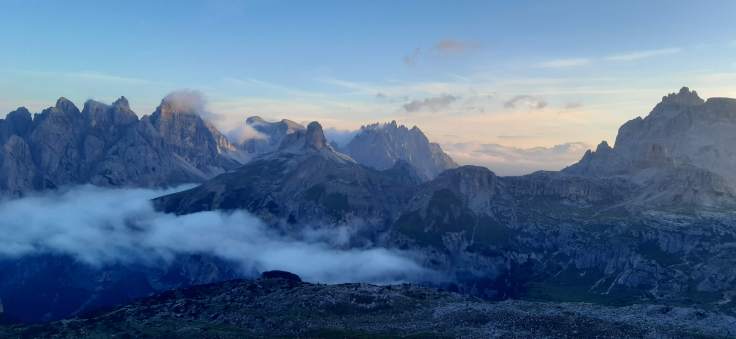
We had a fast changeover at the belay, partly because of the need to maintain a good time, and partly because the Italians would wait for no man. Or woman, apparently. At least the blood had finally returned to my hands and I was now moving decently as we swung leads. The next few pitches were gorgeous: steep, exposed, sustained corner and crack systems on immaculate yellow limestone. Sunrise had painted the surrounding mountains in beautiful pastels, and now the sun was fully up the views were phenomenal. Rugged peak after peak marched into the distance, and somewhere unseen a herd of cows grazed, their bells echoing off the walls and creating the clattering soundtrack of the day.
The atmosphere, the views, the climbing, it would all have been pretty perfect – if not for the Italians nipping at our heels. They continuously refused to wait until we had finished our pitches, chasing us up corners and making narrow belay ledges distinctly more cramped and uncomfortable. As I set out to second another of the VII crux pitches, the leader of the pair didn’t even wait till I was halfway across the thin and difficult traverse before he started out, invading my personal space and creating distraction I absolutely didn’t need on the hard moves. I finished the traverse section and started to climb upwards – which meant his hands were almost exactly where my feet needed to be. “Watch out!” I snapped at him. He must have misheard me, as he cheerily replied, “Ciao!” Responding, he thought, in kind.
I focused on the climbing and put him out of my mind. Having resisted the allure of the reams of tat available for aiding, I arrived triumphant at the belay but badly pumped, having not felt able to stop for shakeouts. The belay was small and the pegs not completely confidence-inspiring. Soph shouted down that he would have to wait where he was – there was no room for three up here. This time he responded only with the universal groan of someone struggling on rock and I hoped fervently, and not unjustifiedly, that he would get pumped and fall off. He didn’t, but he did at least drop back and they gave us some breathing room after that. I was able to thoroughly enjoy the next few pitches until a large ledge at the end of the ninth pitch signalled the end of the hard climbing.
We moved onto easy ground, moving rapidly, fairly running up low grade pitches, making good time. We were, however, about to trade lower grades for sodden corners, and I bridged up a horrible chimney, making cries of disgust every time I put my hand in a puddle-filled pocket, or took a cold drip straight into my upturned face. Chalk melted away the second it saw the rock and a muddy paste coated my shoes and hands. I pulled into the cave at the top of the chimney, proclaiming it as “the most disgusting thing I’ve ever climbed.”
Thankfully things picked up for the final couple of pitches and before long we had made it to the ring ledge that encircles Cima Grande just below the summit, a very respectable 8 hours after we left the ground. But the day was not over. Far from it. We had to get down.
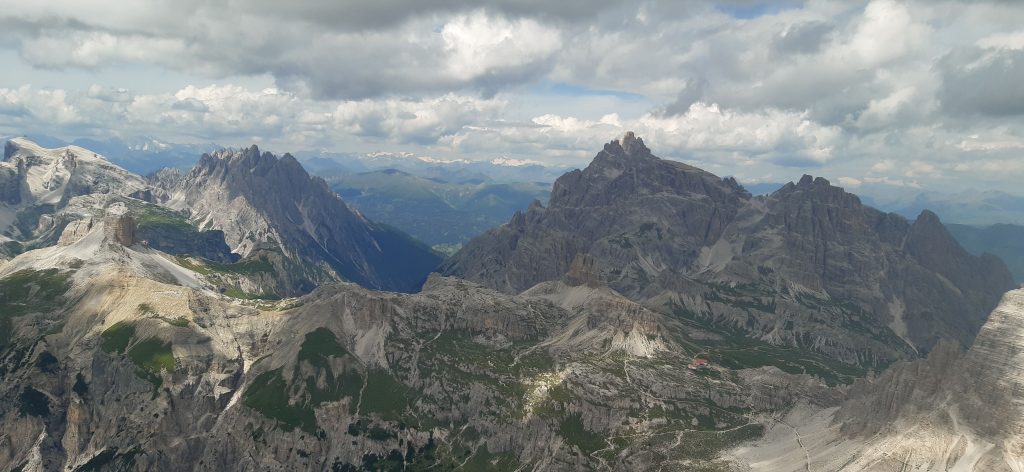
The first step was to get from the north to the south side of the pillar. This consisted of a narrow, loose ledge that weaved into corners and out around aretes, making moving together difficult. At one point I had to crawl on hands and knees under a roof, and while reaching gingerly over a collapsing corner, I reflected bitterly how awful it would be to have made it to the top safely, only to take a fatal tumble on the “easy” part. We also passed rocky, hastily erected walls, the remains of forced bivvies taken by climbers far unluckier than us that had had to pass the night 500-odd metres in the air. About an hour later (a testament to how big the Cime are!), we finally found the cairn that signalled the start of the descent proper, and the string of abseils that would bring us to the ground. After what seemed like infinite abseils, endless scree and a surprise run-in with some super-cute marmots, we were back on the gloriously flat, solid path, four hours after we actually finished the route.

We had a further two days of climbing before it was time to head home, and I cannot even begin to describe how exhausted I was by that final day. Dragging myself up single pitch sport routes before heading back down to Venice, it felt like everything had been scooped out of my forearms, leaving nothing but hollow tubes. I was very much ready to either go home, or to simply collapse into a million pieces.
What an incredible experience though. I won’t deny that there were large chunks of the trip that fell squarely into the Type 2 fun category. Sure they were phenomenal experiences, but the huge routes were definitely experiences. It can be incredibly stressful on these enormous multi-pitches, and even when the climbing is easy you must be fully switched on at all times. You’re constantly thinking about the weather, your pace, the route finding, the loose rock, the potential of getting off before dark, staying warm, fed and watered, and needing to navigate weeing – or worse – on narrow ledges, in a harness and usually in very close proximity to your climbing partner. In addition to being physically exhausting, it’s mentally and emotionally draining. It’s also a lot to take in. By the time you pull over that final edge and on to the top, the best climbing might be 12 pitches and 6 hours behind you, and therefore actually quite difficult to remember.
It might have taken me nearly two weeks to fully recover, but don’t get me wrong, I loved it. This trip has opened up a whole new world of rock and adventurous climbing for me and while I’ll still be thinking long and hard about anything that involves snow or a bivvy, I will definitely be returning to these incredible Dolomite peaks.
Just… give me a year or so to forget about the hard bits, yeah?
*The tunnels are truly incredible. When the Italians entered WWI in 1915 on the side of the Allies, the Austro-Hungarian empire already held much of the Dolomites. The peaks of these mountains were literally the front line. The Austrians were ensconced on the top of Laguzuoi Piccolo, in the ideal position to bombard the Italian supply lines in the valley below. Undeterred, the Italians simply dug into the cliffs, tunnelled up 1000 vertical metres of rock, and blew the top off the mountain, and the Austrians along with it. Which is mad when you think about it really.
 Kate Harrison Writes
Leave a comment