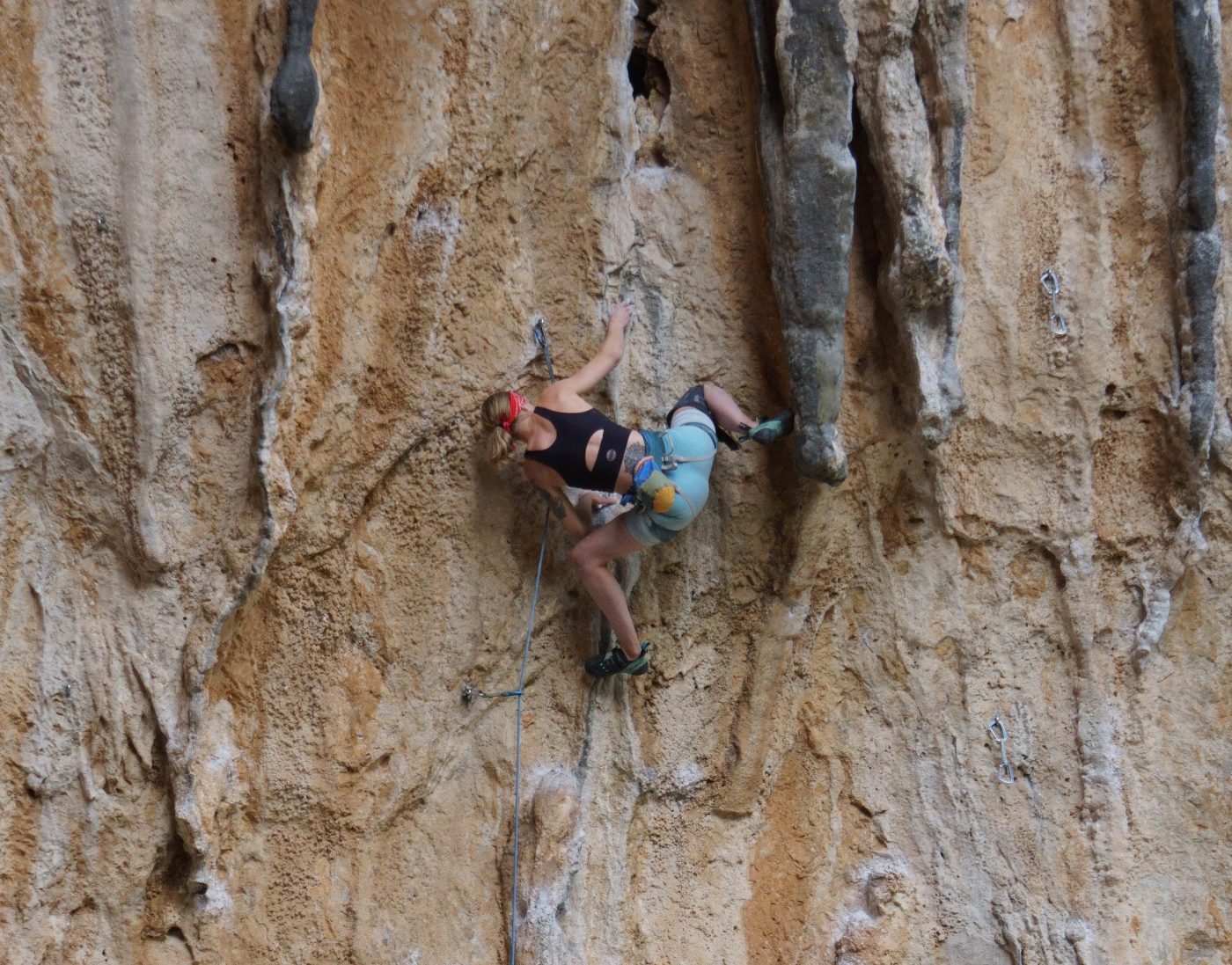
Back in November, I achieved one of my lifetime climbing goals – I sent an 8a sport route.1 Outside of the niche community of other climbers, this is, in effect, a meaningless number. Just know that this is very hard. Not the hardest, but if the grading scale goes from “3” to “9c”, it’s pretty high up there.
My partner and I were in Turkey for a month-long trip to Datça, a coastal town on the Reşadiye Peninsula in the south-west. This relatively recent climbing venue plays host to an incredible crag, an enormous limestone cave dripping with stalactites and tufas, with difficult routes as long as 80m winding their way around the hanging rocks. Where previous trips here had been about quick hits, working my way through the grade sevens, I had intended this trip to be one for red-pointing, to choose a route harder than anything I’d tried before, take advantage of the four weeks and lay siege to it. Having focused my training in the run up to the trip, I felt strong and fit, and so picked a route. It came together steadily, and after about five sessions I made it all 33m, bottom to top without falling off. I had sent my first 8a.
8a is a bit of a landmark grade for sport climbers. The first of any new grade is one to be celebrated and since the vast majority of climbers spend their lives bopping around the 6s and 7s, breaking into the 8th grade is often seen as the moment you start playing with the big boys. While the clean send of a red-point project can often be a bit of an anti-climax, more relief that you don’t have to do it yet again than anything else, it can sometimes be absolutely ecstatic. This was one of those times. I had achieved something I never thought possible, something I had worked really hard for. I walked on air for about 48 hrs – longer than my usual post-send high – before the joy cooled and I was back down in the trenches.
I had climbed 8a. Why then, just 3 days later was I close to tears of frustration, repeatedly falling off the final move of a 7b+? I had just done 8a! wasn’t I a hard climber now? I should be able to do a 7b+!
“Should”, it turns out, is a loaded word.
That day, “should” was doing me absolutely no favours. The more I thought that I should be able to do it, the more I became convinced that my foot sequence for the crux should work, and I got more and more frustrated when it repeatedly didn’t. Eventually I acquiesced, changed my foot placement, and sent almost immediately. But the frustration lingered – I felt as though I had already failed to live up to my previous performance. By the time we returned to the UK, the Welsh December weather was making it far too cold to sport climb outside, and it would be several months before I climbed a sport route again and contended with all the expectations I had built up in the Turkish sunshine. Instead, I spent my winter bouldering, something I had been very much against in previous years, lacking psyche for both the art of bouldering itself, and standing around outside in frigid temps.
As I have mentioned in previous posts – I’m really not very good at bouldering. My strengths lie in endurance rather than power or, well, strength. Like a marathon runner trying to do a 100m sprint, my carefully honed skills (being really good at just hanging on for a really, really long time), essential on a 40m trad route, are basically useless for getting up 4-8 moves of steep, thuggy boulder problem, despite them both falling under the same umbrella term of “climbing”. This winter though, I took it as a challenge. Many of the sport climbing routes in the UK have bouldery cruxes in the middle, and without the power to get through them, I was risking hitting a (metaphorical) ceiling and falling even shorter of my expectations. So, at least once a week you could find me bundled up against the cold, in abject misery, waiting my turn to strip off layers only for the brief few seconds required to manage two moves before inevitably falling off. In short, despite trying my very best, I spent the winter failing. As the months progressed, and the idea of sending any boulders at all became an unachievable dream, I began to break down my preconceived notions of success, and the word “should”, shrinking my bouldering expectations down from ticking problems at my goal grade to just incremental improvements – one move here, a pull feeling easier there – and simply just having a nice time outside with friends.
This recurrent familiarity with failure was good for me, breaking down my ego, making me somewhat less reliant on the validation of ultimately subjective and meaningless numbers for self-worth. But while I did get stronger, I also began to dread the return of the warmer weather and the sport climbing season. What if I couldn’t do another 8a? What if my Turkish route had been a fluke, and I fell short of all the expectations I had set for myself in the wake of it? What if I went backwards?
It’s easy to give into this fear of going backwards, and deliberately position myself into ruts that avoid the possibility of not living up to expectations. One such rut is to avoid anything even the slightest bit hard or close to a grade that I’ve pushed myself on in the past, staying on routes I know I can definitely do to keep reaping the minimal rewards of easy ticks. Another is to pick routes I know are far too hard for me, where the lack of progress is a comfort zone – it doesn’t matter if I don’t send because I never expected to anyway.
I can readily admit that I have been guilty of languishing in both of these ruts at times, and it takes real conscious effort to break out of them. To accept that yes, things might not go my way, I might not be able to do the route I feel like I should be able to send. To make the conscious choice to climb for reasons other than to simply “get the tick.” Unfortunately it’s not as simple as deciding one day that I’ve risen above it and that I’ll never experience the frustration of should again. It’s a constant, active battle. Choosing to not sink into misery when I fall off or can’t figure out the beta. Choosing to remember that no matter how much it sucks to fail now, how much will that route matter to me in a week, a month or a year? Choosing to redefine success- sport climbing in particular is utterly arbitrary. Unlike bouldering or trad climbing where you (usually) climb all the way to the top of the cliff/boulder, the route ends where the setter decided to put the chains, meaning you’re conforming to someone else’s idea of success. Why not just create my own idea of success instead? Taking a fall that I was nervous about, trailing a new beta, or trying a route that isn’t my style, all these can be considered successes, with the right frame of mind.
Perhaps, though, I need a little should. Perhaps should can be a spotlight, highlighting things that need work:
“I should be able to do this route, but I got too pumped and fell off, so I need to improve my endurance.”
“I should be better at bouldering than I am, but there still seems to be some core element missing that I need to figure out and then work on.”
Maybe should only has the power that I give it. If I make should a motivator rather than a stick with which to beat myself, what can it drive me to achieve?
So, after my winter of glorious failure, how has my spring of sport climbing gone? Well, I chose my UK 8a, sieged it, and was making good progress, until I sprained my wrist working on it and the decision was taken out of my hands. I’ve still been able to climb, but that particular route, with its five vicious sequential undercuts, has had to take a back seat. In a way, it’s almost taken the pressure off. The noise of expectations drowned out by the pain surrounding the head of my ulna2, allowing me to explore other routes, other goals. There are of course expectations tied up in those too, but they seem looser, less suffocating, less planned.
Ultimately there is no shame in going backwards. We cannot perform at our very best all of the time, nor should we expect ourselves to. This is especially pertinent for me, considering that high-grade climbing is 99% failure anyway by the standard definition of “the send”. Though I have yet to do another 8a this year, I have climbed plenty of good routes, and succeeded at the most basic goal of outdoor climbing and the antithesis of expectations: just getting outside and enjoying myself on rock, and that should be all that really matters.
 Kate Harrison Writes
Leave a comment