
There are some who would describe the pinnacle of rock climbing as the flow state, the dance that you do when you know the moves inside and out, rehearsed a hundred times, muscle memory feeding you hold after hold. A higher plane of concentration, perhaps not even having to think about it at all.
I am not one of those people. I love the down and dirty fight of an onsight. Not knowing what you’re getting yourself into, having to take everything as it comes, fix mistakes on the fly and dig deep to keep going. Tufas are a perfect example of this. So, give me a few minutes of your time and let me take you on a little journey up the side of a Turkish cave…
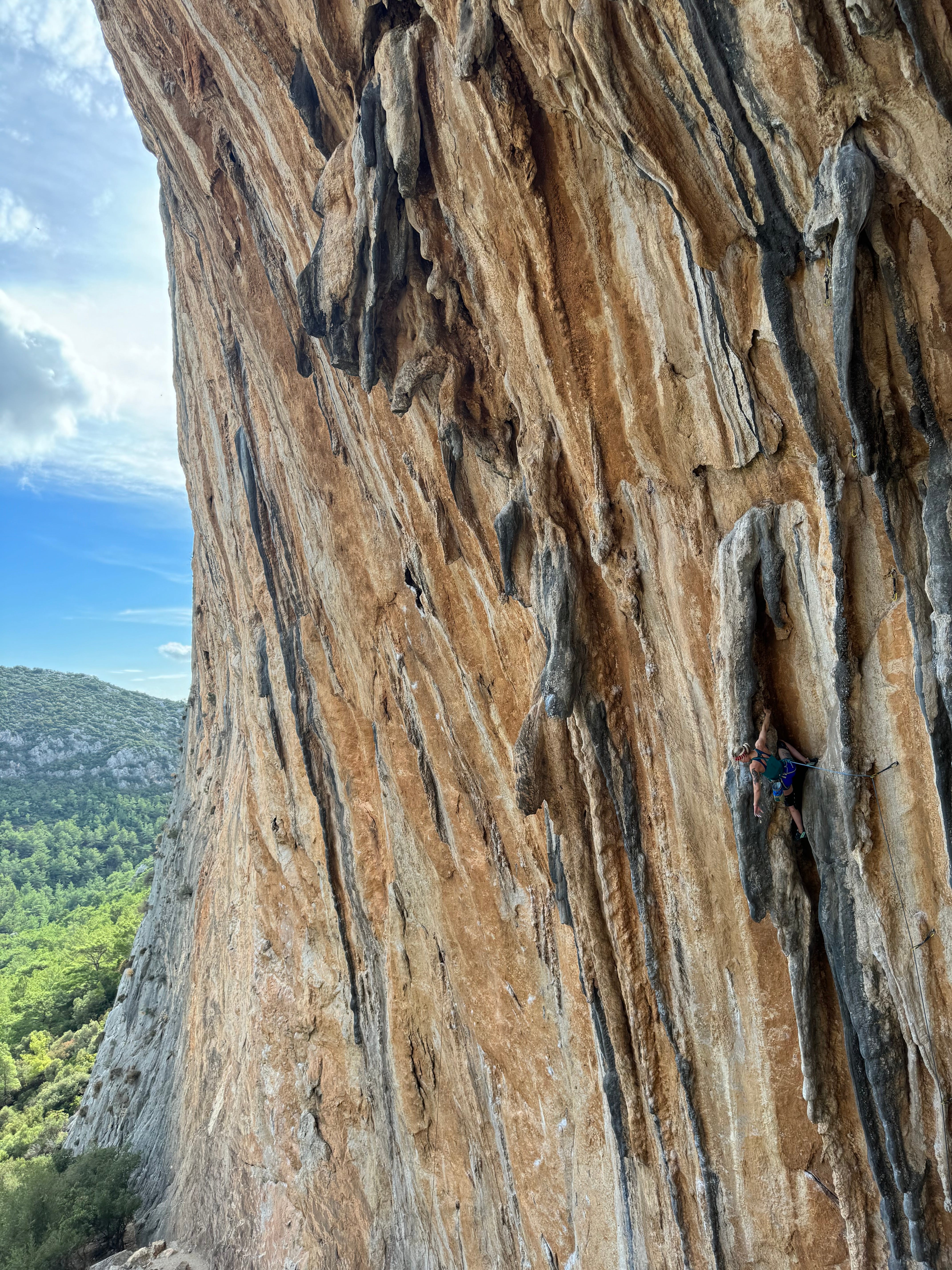
It’s hot today. Of course it is. It might be November, but the Mediterranean sun still beats down, a lazy pressure on the back of your neck and shoulders. You’ve stripped down to shorts and a sports bra but you can still feel the sweat pooling in the small of your back, running rivulets down your breastbone. Though the rock is in the shade, you know that the limestone will still pulsate with heat, absorbed from earlier in the day before the sun shifted around the corner. Your belayer has clipped the first bolt for you already, and the rope hangs down through the quickdraw, waiting. You tie it into your harness, an automatic figure-8 knot. You’ve done it so many times you could do it without even looking, without thinking, but you still check and double check, just in case – complacency breeds accidents.
You sit down to cram your feet into your rock shoes, and take the opportunity to look up at the route you’re about to climb. Really take it in. Your head keeps tilting, craning backwards, the chains, your goal, so high up it’s hard to even see them. 35 metres of tufas curve steeply above you. Centuries, millennia even, of water seeping through the cliff and trickling down the walls, stalactites that never managed full independence, instead forming columns attached to the cave down one side. All that time, all that effort, drop after drop of water, all coming together to form this beautiful climb. Maybe, you can even kid yourself, they did it just for you.
Tufas are your favourite style of climbing. Once you loved the technical, crimpy dances of perfectly vertical rock, but these pale in comparison to the brutal, burly joy of wrestling with a tufa. You stand up and strap rubber pads on to your thighs – they’re called knee pads, but the scabbed, swollen and bruised state of your knees suggests they protect your thighs more. You cinch down the straps tight and do some experimental squats – they must be tight enough to stay in place when wedged against the rock, but not so tight that they restrict movement – tufas are a whole-body affair and everything needs to be responsive when you need it most.
Your belayer asks if you are ready. The other end of the rope is already threaded through his belay device, the only thing left is you. You take a few deep breaths, calming your nervous mind, settling your heart. Now is not the time to contemplate the whole route, just the next immediate step. You wipe the dust off the tips of your shoes on opposite shins, and with one final sharp exhalation, you begin. The start of the route is a slab, a few metres of easy moves, and you pad up quickly before balancing at the point where the wall suddenly steepens, taking a breather before the real meat begins. The tufas don’t start for a couple of metres yet, and you move initially on thin ledges and pockets in the rock, crossing hand over hand and stepping up through the steepening territory to where the first of the huge stalactites hang down over your head. Now the real fight begins.
You reach as high as you can up the tufa, pinching the wide column, hoping that there might be an in-cut for your fingers to curl in to. Your feet follow and you smear the tip of your toe on a tiny mound of coral-like protrusions and tilt the bent knee against the side of the tufa, jamming it behind the swollen limestone. The rubber pad on your thigh takes both the friction and the pressure, and the other leg hangs gently, unneeded, as your entire weight presses between the two points of contact. You reach out, clip a quickdraw into a bolt then look up, scanning the rock the next holds, the intended route – once you commit to moving, there will be no respite until you find the next rest. You still feel fresh, ready for whatever the route throws at you, but you know full well that this is impermanent.
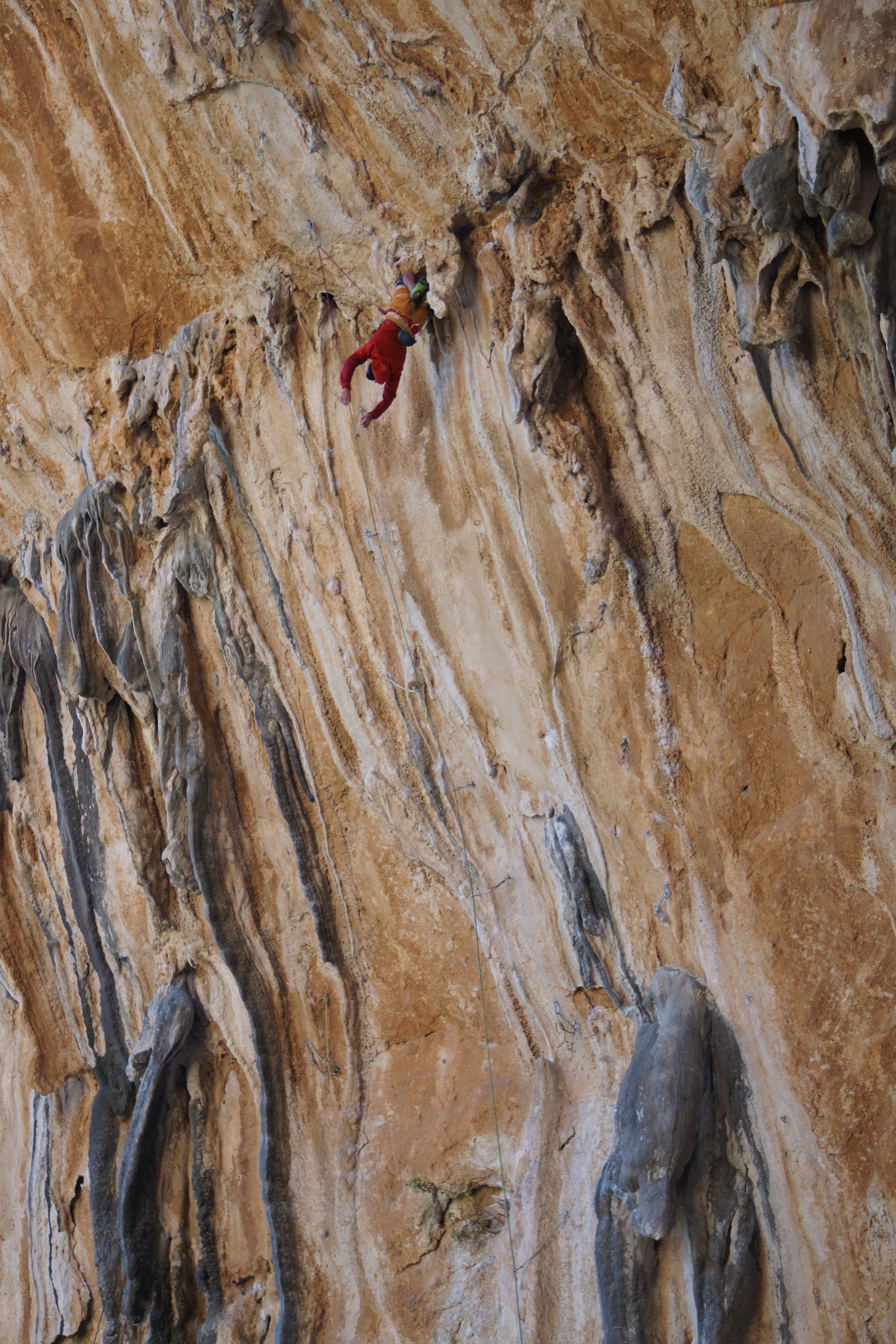
The rest gives your forearms and fingers a break but you can feel the pressure mounting in your calf, a build-up of lactic acid burning in the muscle – it’s time to move on. Up the tufa you climb, hand over hand, shifting your weight from one side of the column to another, almost like batman up the side of a building. You clip each quickdraw as you come to it, the rope hanging down behind you, an anchor to safety, a reminder that you’re not alone, though already high up on the wall, it certainly feels like you are. The holds on the edge of the tufa are wide, and holding them is rapidly draining the energy out of your forearms. Eventually, you’re able to move into a channel, a canal between two of the great pillars. Feet bridged out against each tufa, you are all too aware of the distance to the last draw below you. If you fail in this next move, you’ll fall to that draw, then that distance again, a long, screaming, instantaneous drop that will leave you dangling in space, the end of this attempt. The next bolt is above your head, and no matter how you stretch up, it remains desperately out of reach. You shift up onto tip-toes, all too aware of how little contact remains between the tip of your shoes and the rock, arm pulling, shoulder at full extension, each extra millimetre a taking you closer to the safety of stainless steel. You hold the carabiner where it meets the nylon webbing of the quickdraw, using it to make you that little bit taller, pushing the gate against the edge of the bolt.
It won’t open.
At this extension, you can’t quite generate enough pressure to let the bolt slip inside the carabiner. You will yourself to reach further as if sheer force of conviction will manifest just a couple of millimetres more, breath coming in tiny, panicky gasps. “Go in you bastard,” you hiss between gritted teeth, as you feel the rubber soles of your shoes, smeared against the rock, start to shift, to slide. The clock is ticking, ticking, ticking. At last the gate opens, and the quickdraw latches the bolt. You compress yourself back together, a chalk-covered accordion, fully weighting your feet again, clip the rope in and breathe a sigh of relief.
But relief is short lived. There is a rest here, but it isn’t great – you can’t stay here long. You try to focus on slowing the heart that feels like it could thump right out of your chest; you’ve still got metres to go, and the final section is the most sustained. A full-body fight with an enormous tufa, it will require every point of contact you can dream up – the long, wide slit at the back of the tufa where it meets the wall eats up knees, hands, shoulders, forearms, feet. You grovel your way up the groove, technique and style forgotten, lactic acid building up painfully in every limb, each movement accompanied by a high-pitched grunt of effort, breaths short and rapid, each movement harder to make than the one before, requiring you to dig deeper and deeper inside yourself for more willpower, more determination not to just give up and let go.
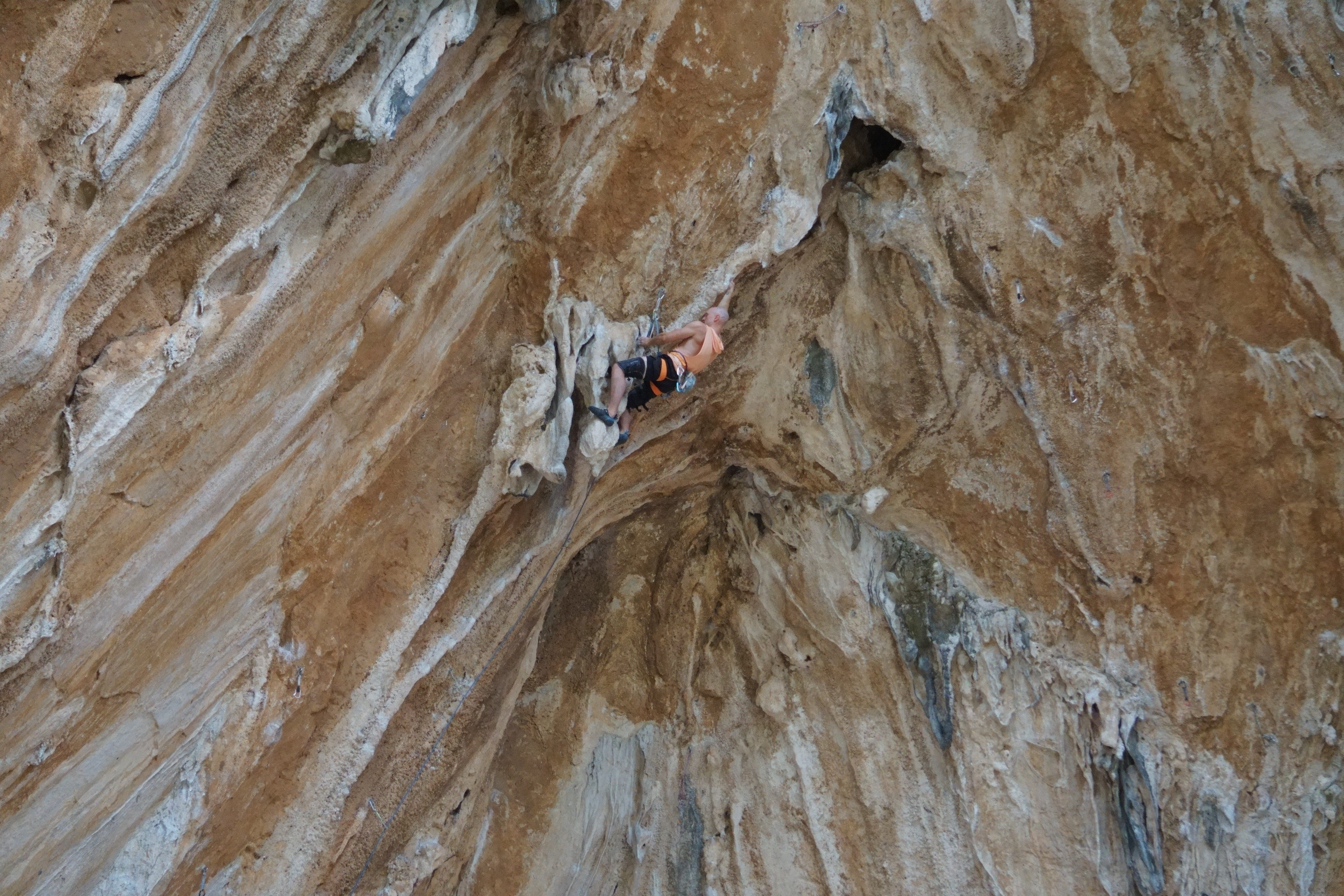
You jam both hands up into the top of the slit, hoping the knobbly sides will catch on your clenched fists, wedge them in place so you can drag your feet up onto tiny, corally clusters. If your hands were bigger, they would fit perfectly, feel secure, but instead they rattle slightly behind the tufa, not quite wide enough to fully trust. Not that you have a choice. Without warning, one foot slips off its hold. You spit out a reflexive shout of surprise, bitten off as all your weight drags on your jammed fists and without thinking you clench them even further, tensing every muscle to maintain tension and stick the jam. It works. You’re still on the wall. You find a better foot and allow yourself a look upwards. The chains are so close, the top of the route only a couple more moves away, but your forearms are screaming, your whole body redlining, and in that moment, holding on feels like the hardest thing you’ve ever done. It takes everything you have to move upwards and you reach over the rounded top of the tufa to grasp at whatever you can find. Your efforts are rewarded – a jug, a beautiful, glorious jug, easy to hold, fitting your hand perfectly like the handle of a bespoke mug. You grab it with both hands and use it to drag your body onto the mound, almost straddling it, riding it like a pony. The last thing you need to do – can’t mess it up now – you clip the chains and whoop with joy.
You’re done.
“Okay, bring me down!” you call to your belayer and they lower you to the ground, far faster than it took you to get up there. The route overhangs by so much that you touch down several metres behind them, and you bend over, hands on knees, panting, feeling like you might be sick from the effort. The full-body pump lingers, and your forearms feel themselves like rocks, veins standing out, straining at the skin with the effort of keeping your body moving under such pressure. It feels simultaneously horrible and fantastic – painful evidence of your well-fought battle, the satisfaction of giving something your everything, every drop of power, of energy, of fight.
As you stand up to untie your knot your belayer approaches, arm outstretched for a congratulatory fist bump. You wipe the sweat off your forehead with the back of your hand, leaving a smear of chalk.
“Alright! Which route shall we go for next?”
No AI tools have ever or will ever be used to write or help write this blog.
Thanks for reading! If you enjoyed this, please consider supporting my work by subscribing:
Or, if you’d like, you could help me climb more tufas by contributing to my chalk fund.
 Kate Harrison Writes
Leave a comment