
Before Tuesday, I had seen a grand total of one red squirrel in my entire life. A barely remembered russet flash on a childhood holiday in Northumberland, even now unsure if I even saw it myself or if I just remember my parents getting excited about it. By the time I was old enough to be aware of them, the grey squirrel dominance had been in full swing for decades, and the privilege of seeing a red felt like something mostly confined to the incredibly lucky or incredibly patient in the wild Highlands of Scotland. 1
So when someone recently told me that Ynys Môn (Anglesey), just an hour’s drive down the coast, had a booming population of red squirrels, I had to go see for myself.
Ynys Môn has only recently become a red squirrel stronghold, after a concerted effort to remove grey squirrels succeeded in 2016, saving the reds from near extinction on the island.2 Today, the population numbers over 700 spread over a handful of woodland sites, including Newborough Beach forest, Llyn Parc Mawr, and the Nant y Pandy nature reserve in Llangefni.
—
It was a pretty miserable forecast as my Mum and I arrived in the small town of Llangefni. We’d driven through driving rain and sleet, and there was snow just beginning to settle on the mountains. Temperatures were dropping and I had little hope that we would see much at all. I wasn’t even sure if red squirrels were out and about in the winter, or if they were hibernators. I very nearly suggested we not bother. But the wooded nature reserve was literally right next to the town car park, and we could at least go and have a nice – if damp – walk. Almost immediately after entering the trees, we saw a guy sporting a camo vest, and the kind of camera to give anyone lens envy. Mum, never afraid of starting a conversation, asked what he was on the search for. Unsurprisingly, it was red squirrels. Last year, he said, there had been a feeding station just off the main path, and there had been loads about… but this year the station had disappeared, and so, it seemed had the squirrels. “I’ve been here half and hour and I haven’t seen a single one yet,” he reported.


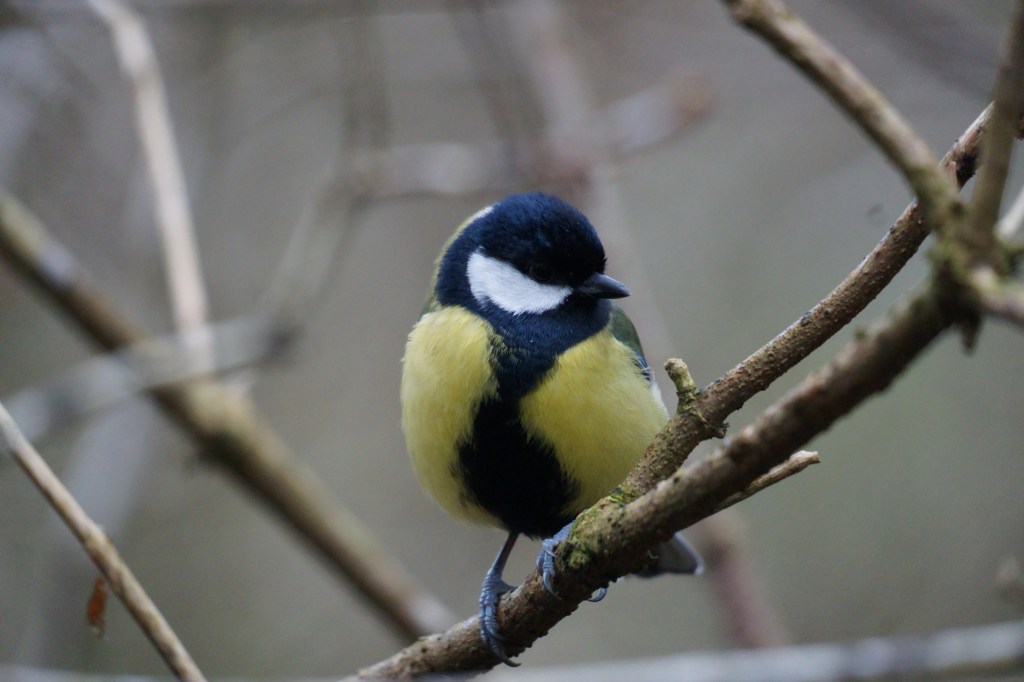
We moved on, with little optimism. At least there were plenty of birds to keep us from being too disappointed. The trees rang with a concert of birdsong, and robins, tits, blackbirds and finches flitted through the trees while somewhere in the middle distance, a woodpecker hammered methodically. Clearly not shy of people, the birds gathered every time we paused to scan the trees, clustering around us – probably in the hope we had seeds to share. I will never get tired of common garden birds. Some people may think them dull, but their beauty is obvious for those who want to see it. Blackbirds of such a rich black to be almost purple. The weak February sun catching navy tones in the cap of a great tit. The personality of the chaffinches, lively and bold. At one point there must have been over a dozen birds watching us from the tree immediately next to the path, mere feet away.
The birds kept up with me as I crept slowly along the path, eyes glued to the treetops for dreys, or that tell-tale red flash. Mum had drifted slightly ahead, and suddenly she span round, hissed my name and beckoned me quickly. I hustled to her, trying to run as quietly as possible and looked where she was frantically pointing. There! In the upper branches of a tree, scampering along the limbs faster than I could track with my camera. It was gone, down a trunk and deep into the undergrowth before I could take a photo, but it was as if that first one had opened a gate, because it wasn’t long before we saw another, and another, and another.

They bounded acrobatically from branch to branch, lither, smaller and faster than their grey cousins, and I was struck by how much more comfortable they looked in the trees than greys – though of course they would – these slim trunks and narrow branches had always been theirs. The briefest of pauses, and I managed to react fast enough to hit the shutter button, capturing long, thin toes wrapped around a branch and the characteristic winter tufts shooting up from the ears like two russet feathery plumes on a medieval helmet. Despite the rain, I was glad we’d visited in the winter – dense foliage would have made them almost impossible to spot!

I couldn’t understand how the photographer we’d seen earlier had failed to see any – in the space of ten minutes, three different squirrels flitted around the trees, each with with slightly different markings or tufts, and one such a deep red it was almost black. Where had he been looking?? I swung my camera about trying desperately to keep up, and was eventually rewarded when one came down to the forest floor to forage fairly close to us. It seemed unperturbed by the presence of people – this is a popular walking path after all – though it kept one beady black eye locked on me as it gnawed on the treenut it had uncovered, tail curled up along its back like a mohican.

The rest of the walk around the reserve followed much the same pattern – we would pause to watch a bird or a squirrel, or say hello to yet another robin,3 only to turn around after a couple of minutes to see a cluster of birds watching us from arms’ length away, or another red squirrel foraging within metres of the path. It was almost unbelievable how many there were, what a shattering of low expectations. With all that practice available, I even improved a bit at tracking them in their acrobatic movement through the branches, once even managing to capture one as it paused mid-run for the world’s fastest face-wash.

But the crowning moment of the day was on the boardwalk that snaked through the lower half of the reserve, bridging the boggy ground by the river. Distracted by a particularly posing robin, I almost didn’t notice the coppery blur bouncing down the branch right next to me, until the last second when it jumped onto the fence and hurtled directly towards me, leaping off at the last second and running across the planks just inches from my feet. Mum couldn’t help but laugh as I turned towards her in joy, my mouth a round “o” of surprised delight. It’s safe to say that the squirrels here are very, very used to humans – but when the population is clearly flourishing it hopefully isn’t doing them any harm.

With that, the rain got heavier and the temperature dropped further and we began to make our way towards the car, still escorted by robin after robin. Just before the edge of the woods, we spotted one final fluffy tail, one final squirrel to wave us off. I couldn’t believe it – from such low expectations we’d seen at least ten different squirrels, thriving in that little patch of woodland in that innocuous little town. Despite the sheer number, each one was a fresh delight – familiarity certainly did not breed complacency, and I was equally excited by each and every one. With the help of enthusiastic local populations the news of tentative expansion into burgeoning populations over on mainland Gwynedd, I hope to be equally delighted by many more in the future.

No AI tools have ever or will ever be used to write or help write this blog.
Thanks for reading! If you enjoyed this, please consider supporting my work:
- Introduced to the UK in the 1800s as a display species for stately gardens, and something that the nobility gifted to each other (the Victorians, at it again) grey squirrels were quickly able to out-compete their smaller cousins for resources, and introduced squirrelpox, against which the poor reds had no defences. ↩︎
- For more info, check out https://www.llynparcmawr.org/red-squirrels/ and https://www.redsquirrels.info/about/ ↩︎
- Nothing says “people are definitely feeding these birds and resources are beyond abundant” like masses of robins living in the same area and not fighting about it. ↩︎
 Kate Harrison Writes
Leave a comment