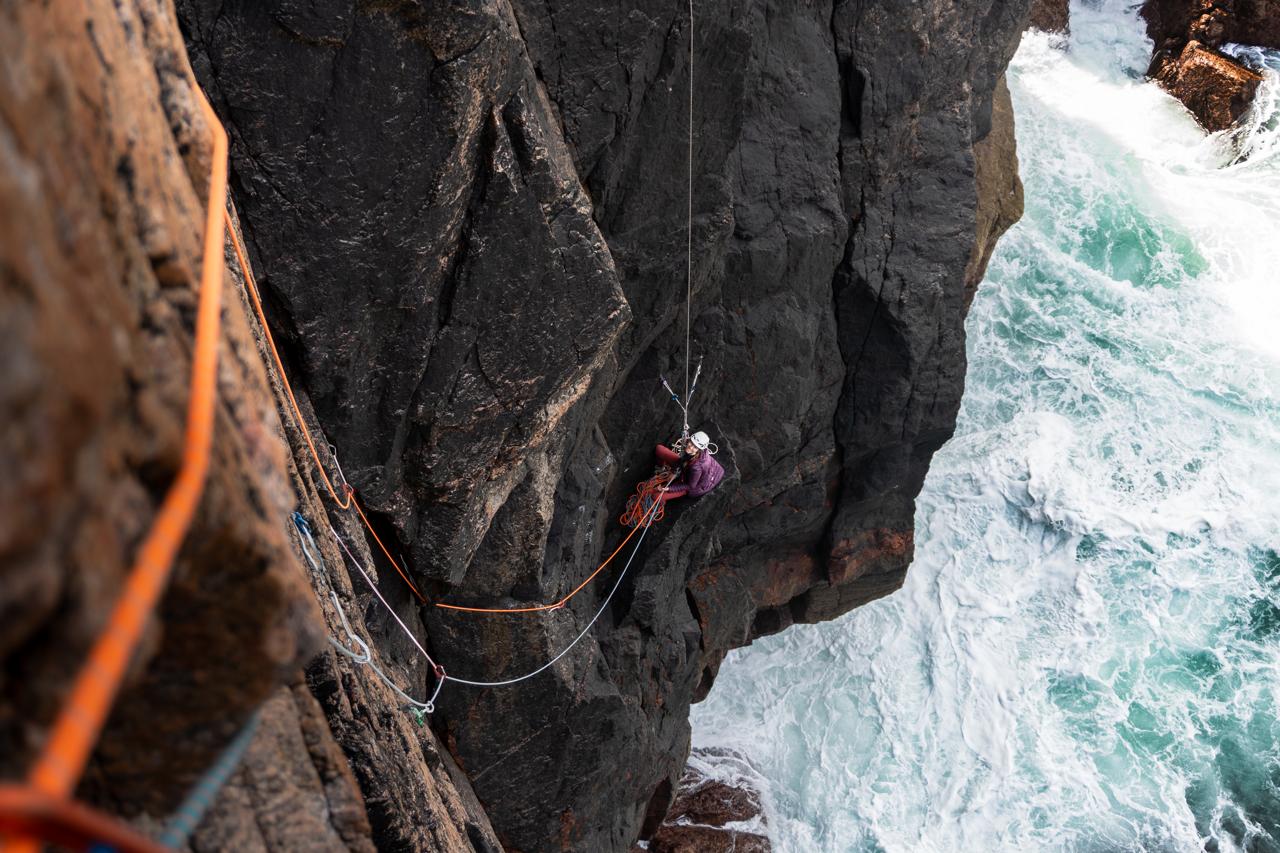
The sea is a cruel mistress, they say. If you had only ever known the sea as I see it now, writing this in the van, you might be hard-pressed to believe the old saying. The orange glow of the sunset is slowly fading into the deep blues of twilight over the ocean, and the perfect, glassy mirror reflecting the shadowy hills with barely a ripple looks no more cruel than a gentle breeze on a summer afternoon. But this is just a different expression on the same face, a calm meditation in comparison to the white-topped rage of this afternoon.
Up in the far, far northwest of the Scottish Highlands, a five-hour drive even from Fort William, almost as far north as you can get, is a long, winding, single track road that leads to the tiny village of Sheigra. In addition to a dozen or so houses, a cemetery and a white sand beach that wouldn’t look out of place in the Caribbean, Sheigra also boasts a couple of truly stellar sea cliffs with some of the most fun trad routes I’ve ever done. I came here last May, when a wet forecast in the south of France forced my friend Sophie and I to change our plans last minute from driving down to the Verdon Gorge, to chasing the only optimistic (and very surprising) forecast in western Europe that week – the far northern sea cliffs of Scotland. The gamble paid off and we were richly rewarded with 8 days of wall-to-wall sunshine, kicking off in the gneiss-walled geos1 of Sheigra. I loved it here, and have been desperate to introduce Chris to its juggy, pocketed charms. It was, therefore, the perfect place to begin our UK summer van exploration.
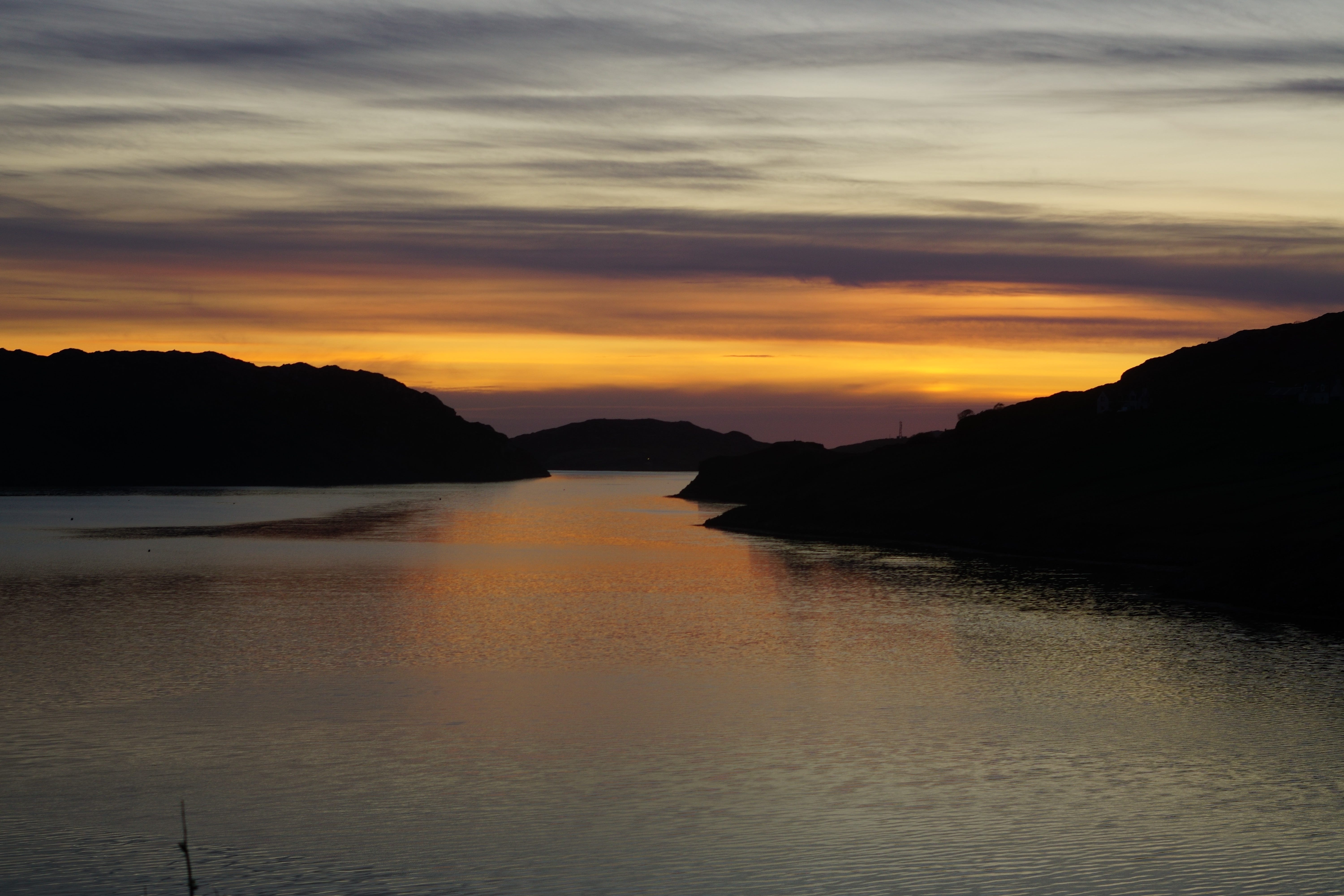
In the second geo, a 30m abseil took me down to a ledge, a couple of feet of jet-black rock sloping in towards the cliff face – wide and comfortable, as far as belay ledges go. The rock was still chilly, waiting for the sun to shift west enough to bathe it in the warm spring light, and I huddled down inside my jacket. From here, I could see down into the deep fissure of the geo, a slash of erosion between two sloping black fingers worn down to red-brown by the relentless passage of water. On the right, pink quartz bands crisscrossed the flecked orange of the face that hovered above a huge sea cave, a headwall dotted with pockets and breaks that would soon be leading Chris back to the top. Sooner rather than later, I hoped as I peered down at the water below.
Last time I was here, on this same ledge, belaying this same route, the sea was docile. A deep teal green, it pulsed gently, carelessly at the rocks as if it had nowhere else to be. The white foam on top was spread thin, separating and curling lazily. Its endless movement was soothingly hypnotic, and as I gradually fed the ropes through my belay device it was easy to reach that perfect balance of concentration and peace that is afforded only to the most beautiful, comfortable belays.
Today though, today was a completely different animal. At odds to only a gentle breeze, a huge swell relentlessly pounded the geo. My little ledge, normally far enough above the waves to be confidently considered “non-tidal” suddenly felt much closer to the action. The anchor I had built was solid – two good cams – but I still prudently elected to remain attached to the abseil rope as well. Though the chances of me being swept off the ledge by a truly enormous rogue wave were extremely low, it wasn’t a dice I wanted to roll.
“I don’t think atmospheric quite covers it!” I shouted to Chris as he joined me, abseiling down onto the ledge, my voice raised despite his proximity, trying to make myself heard over the crashing water below. He grimaced – pounding waves on an exposed route can send even a solid head game into a spiral. Shortly, he set off on the initial traverse, and my briefly crowded ledge became my own little kingdom once again.
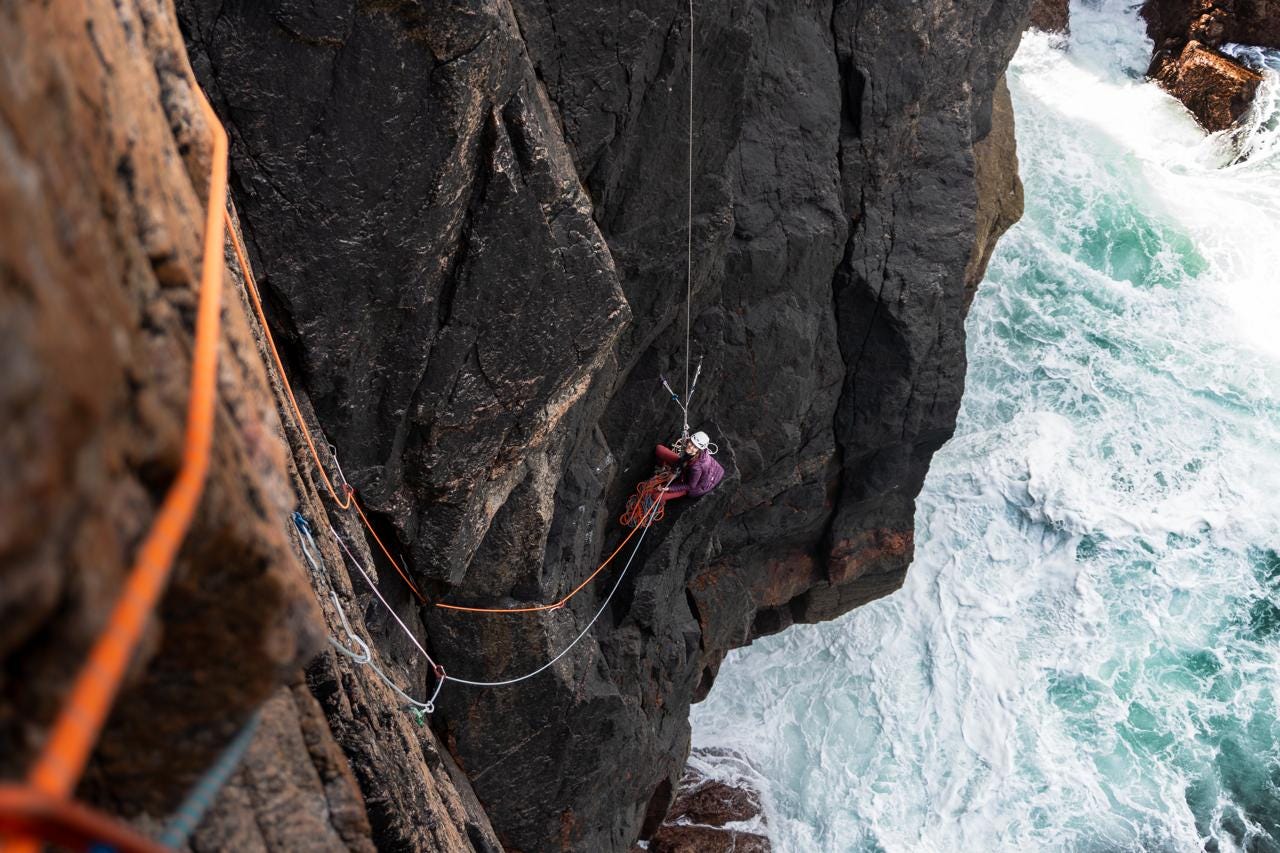
Each movement feeding out the rope was accompanied by the deep bass boom of water flooding into the cave, and the skittering, shuffling sound of it retreating back across rock, pouring off the edges, clusters of foamy waterfalls. It flooded my brain too, a consistent roar that left me straining to listen for Chris’ voice shouting that he had reached the top. Every so often the water would calm, and the sudden silence was more jarring that the noise of the waves, ears feeling blocked for a few seconds before the rushing onslaught burst into action once more.
But the brief moments of quiet were almost always followed by a build-up of huge waves that crashed higher and higher as the tide came in. Spray flew up, higher than my ledge, higher than my head, just inches from my face. The higher it got, the slower it seemed to move, until it hung weightless for a fraction of a second at the apex of its journey, a frozen tableau of soapy white string. I shuffled backwards, huddling into the bottom of my belay, grateful for the slope that protected me from most of the spray. And spray they did – the largest waves threw up so much water that for a few moments it was raining in the geo, a private storm cloud below Chris’ feet, complete with glittering rainbow cast by the sunlight streaming in to that narrow cleft. For once, I could see the point where the rainbow ended, but there was no pot of gold at the end, just roiling water of palest green and white.
One of the things I love most about climbing is how it puts the world into perspective. The calm steadfastness of the mountains makes me and my problems feel comfortably insignificant, a tiny blip on their geological timescale. But the sea, the sea on days like this makes me feel powerless. Not in the panicked, anxious way you get from watching the news these days, but a reminder that whatever mess we humans make, the forces of nature will, even if it takes millennia, eventually prevail. To fall into that mass of water would invite almost certain death. No matter how much of the world humans think we can control, we will never be able to control the sea. No matter how much we kid ourselves, we cannot stop the tides. And eventually, anything we put in its path will be worn away, wave by intractable wave, to nothing.
When Chris finally bellowed that I was on belay and safe to climb, it was with a mixture of relief and regret that I left that ledge. I had become used to the intense noise, the constant movement of the water creating a bubble out of time, a brief separate world away from reality. Still, it would be nice to know for sure I wasn’t about to get drenched. I edged along the lip of the sea cave roof and up the pocketed wall while the water continued to pound into the cave below, that consistent nagging in the back of my head at what lay under my feet making all the moves feel that little bit harder. Back at the bags, as we sorted the gear and coiled the ropes away for the day, we spotted a something twisting lithely in the chaos. A sea otter, its long tail curling as it swam strongly through the foam. For all the force of the water, the violence of the waves, here was something in its element, co-existing with the swell. A reminder of the many faces of the sea, that what can seem like a cruel and hostile environment to one being is home to another. And however calm it looks now, in the cool blues of the twilight, never to forget the power hidden beneath.
No AI tools have ever or will ever be used to write or help write this blog.
Thanks for reading! This publication is entirely unsupported, so if you enjoyed it, please consider supporting/donating:
- A deep, narrow cleft or inlet in a sea cliff, often found in the Highlands and Islands of Scotland. ↩︎


Leave a comment